Skip to content

hotplex Core Architecture Documentation

Read this in other languages: English, 简体中文.

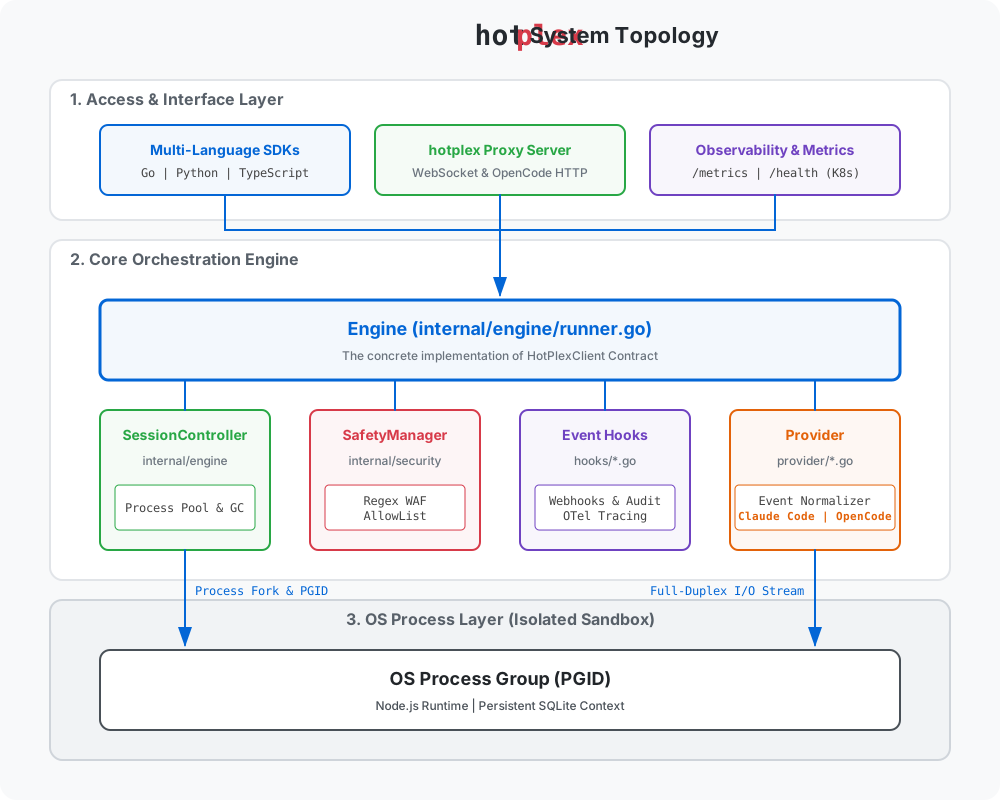
hotplex is a high-performance Agent Runtime for AI CLI Agents, designed to transform one-off terminal-based AI tools (like Claude Code or OpenCode) into production-ready, long-lived interactive services. Its core philosophy is "Leverage vs Build"—by maintaining a persistent process pool with hardened security boundaries and a normalized full-duplex protocol layer, hotplex eliminates the spin-up overhead of headless CLI environments and enables millisecond-level responsiveness.


1. Physical Layout & Clean Architecture

hotplex follows a layered architecture with strict visibility rules, separating the public SDK from internal execution details and protocol adapters.

1.1 Directory Structure (Actual)

  • Root (/): Main entry point for the SDK. Contains hotplex.go (public aliases) and client.go.
  • engine/: The public execution runner (Engine). Orchestrates prompt execution, security WAF, and event dispatching.
  • provider/: The abstraction layer for diverse AI CLI agents. Contains the Provider interface and concrete implementations for claude-code and opencode.
  • types/: Fundamental data structures (Config, StreamMessage, UsageStats).
  • event/: Unified event protocol and callback definitions (Callback, EventWithMeta).
  • internal/engine/: The core execution engine. Manages the SessionPool (process multiplexing) and Session (I/O piping and state management).
  • internal/security/: The Regex-based WAF (Detector) for command auditing.
  • internal/sys/: Low-level OS primitives for cross-platform process group management (PGID) and signal handling.
  • internal/server/: Protocol adapters. Contains hotplex_ws.go (WebSocket) and opencode_http.go (REST/SSE).
  • internal/strutil/: String manipulation utilities.

1.2 Design Principles

  1. Public Thin, Private Thick: The root package hotplex provides a stable, minimal API surface.
  2. Strategy Pattern (Provider): Decouples the engine from specific AI tools. provider.Provider allows switching backends without changing execution logic.
  3. IO-Driven State Machine: internal/engine manages process states (Starting, Ready, Busy, Dead) using IO markers rather than fixed sleeps.

2. Core System Components

2.1 Engine & Runner (engine/runner.go)

  • Engine Singleton: The primary interface for users (NewEngine, Execute).
  • Security Injection: Dynamically injects global EngineOptions (like AllowedTools) into downstream sessions.
  • Deterministic Session ID: Uses UUID v5 to map conversation IDs to persistent sessions, ensuring high context cache hits.

2.2 Provider Adapter (provider/)

Standardizes diverse CLI protocols into a unified "HotPlex Event Stream":

  • Provider Interface: Handles CLI argument construction, input payload formatting, and event parsing.
  • Factory & Registry: ProviderFactory manages provider instantiation, while ProviderRegistry caches active instances for reuse.

2.3 Session Manager (internal/engine/pool.go)

  • Hot-Multiplexing: The SessionPool maintains a registry of active processes. Repeat requests to the same session skip the "Cold Start" (fork) and perform a "Hot Execution" (stdin injection).
  • Graceful GC: Uses a cleanupLoop to sweep idle processes based on IdleTimeout.

2.4 Security & Process Isolation (internal/security/, internal/sys/)

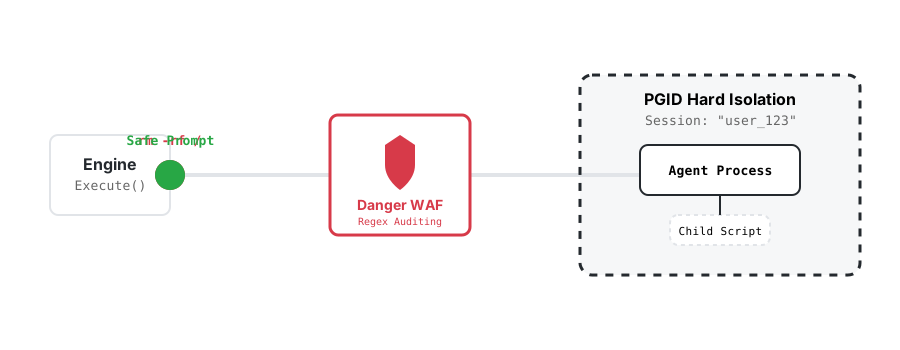
  • Regex WAF: The Detector scans all input prompts for malicious intent (e.g., rm -rf /) as a final line of defense before reached the agent.
  • PGID Hard Isolation: Ensures that the agent and any of its child processes (e.g., a build script) are assigned a unique Process Group ID. Termination kills the entire group via SIGKILL to prevent orphan processes.

2.5 Event Hooks & Observability (hooks/, telemetry/)

  • Webhooks & Audit: Asynchronously broadcasts payload events to external systems (Slack, Webhooks) without blocking the hot-execution path.
  • Tracing & Metrics: Pushes native OpenTelemetry spans and exposes /metrics for Prometheus scraping.

3. Session Lifecycle & Data Flow

mermaid
sequenceDiagram
    participant Client as "Client (WebSocket/SDK)"
    participant Server as "internal/server"
    participant Engine as "engine.Engine"
    participant Hooks as "Event Hooks & OTel"
    participant Pool as "internal/engine.SessionPool"
    participant Provider as "provider.Provider"
    participant Proc as "CLI Process (OS)"
    
    Client->>Server: Request (WebSocket Message / POST)
    Server->>Engine: Execute(Config, Prompt)
    Engine->>Engine: Check WAF (Detector)
    Engine->>Hooks: Start Trace Span
    Engine->>Pool: GetOrCreateSession(ID)
    
    alt Cold Start (Not in Pool)
        Pool->>Provider: Build CLI Args/Env
        Pool->>Proc: fork() with PGID
        Pool->>Proc: Inject Context/SystemPrompt
    end
    
    Engine->>Proc: Write stdin (JSON payload)
    
    loop Stream Event Normalization
        Proc-->>Provider: Raw tool specific output
        Provider-->>Engine: Normalized ProviderEvent
        Engine-->>Hooks: Emit Event (Webhook/Log)
        Engine-->>Server: Public EventWithMeta
        Server-->>Client: WebSocket/SSE Event
    end
    
    Engine->>Pool: Touch(ID) to refresh idle timer
    Engine->>Hooks: End Trace & Record Metrics

4. Feature Matrix

Core Capabilities

  • [x] Clean Architecture with internal/ isolation
  • [x] Strategy-based Provider pattern (Claude Code, OpenCode)
  • [x] Resilient Session Hot-Multiplexing
  • [x] Multi-platform PGID management (Windows Job Objects / Unix PGID)
  • [x] Regex-based Security WAF
  • [x] Dual Protocol Gateway: Native WebSocket and OpenCode-compatible REST/SSE API
  • [x] Event Hooks: Plugin system for Webhooks, Slack, and custom audit sinks
  • [x] Observability: OpenTelemetry native tracing and Prometheus metrics (/metrics)

Planned Enhancements

  • L2/L3 Isolation: Integrating Linux Namespaces (PID/Net) and WASM sandboxing
  • Multi-Agent Bus: Orchestrating multiple specialized agents behind a single namespace

Released under the MIT License.